|
NEW! Add New Function
Generally, the IPS devices usually use
pattern recognition method to filter anomaly traffic; however, it is
always too laggardly. Curelan Company did not use pattern recognition
but use behavior analyzes to detect UDP Flood Attack. When
Flowviewer detected UDP Flood Attack, it will block the infected
IP through the Core Switch by ACL commands. This can avoid the large
number of packets that generated by the infected IP to pass through
gateway devices and avoid the crash of gateway devices.
Ex. The internal IP of Ling
Tung University had infected and launched UDP Flood Attack.
Following is the figure of the detecting result by using Flowviewer
behavior analyzes.
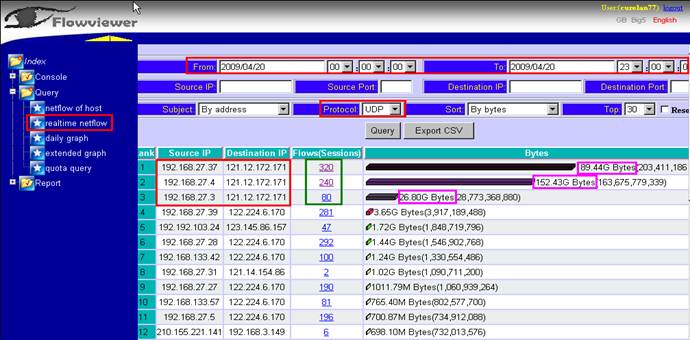
By using the Flowviewer “realtime netflow” function,
adjust the time range from 00:00:00 to 23:00:00 and select UDP protocol
to find out which user generate the most amount of traffic on Apr. 20,
2009. We found that 192.168.27.37, 192.168.27.4 and 192.168.27.3 were
the top 3. The following figures are the detail netflow records of
these 3 IPs:
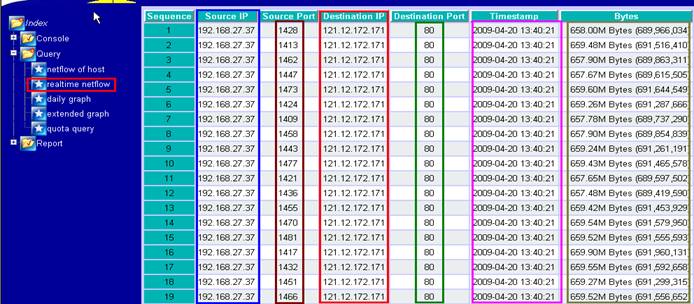
Figure 1
Analysis: Source IP is 192.168.27.37(Private IP) and
Source Port changed all the time. Destination IP is
121.12.172.171(Public IP) and Destination Port is 80. Source IP
generated 658M Bytes traffic per record on 13:40:21 Apr. 20, 2009. As
the above report, we found that 192.168.27.37 had infected and launch
UDP Flood Attack to 121.12.172.171.
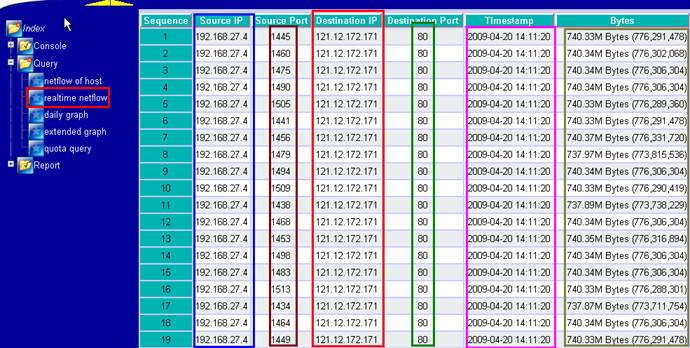
Figure 2
Analysis: Source IP is 192.168.27.4(Private IP) and
Source Port changed all the time. Destination IP is
121.12.172.171(Public IP) and Destination Port is 80. Source IP
generated 740M Bytes traffic per record on 14:11:20 Apr. 20, 2009. As
the above report, we found that 192.168.27.4 had infected and launch
UDP Flood Attack to 121.12.172.171.
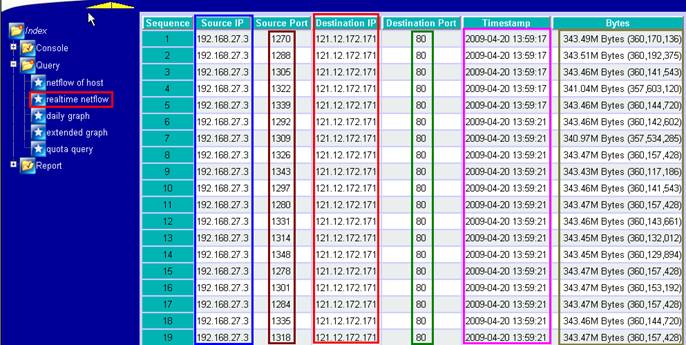
Figure 3
Analysis: Source IP is 192.168.27.3(Private IP) and
Source Port changed all the time. Destination IP is
121.12.172.171(Public IP) and Destination Port is 80. Source IP generated
343M Bytes traffic per record on 13:59:17 Apr. 20, 2009. As the above
report, we found that 192.168.27.3 had infected and launch UDP Flood
Attack to 121.12.172.171.
Conclusion:
1.
From the above 3 reports, we known that UDP Flood Attack can
spread through network. Form the above report, we known that
192.168.27.37 infected the virus first and then spread to192.168.27.3
and 192.168.27.4.
2.
UDP Flood Attack will generate a huge amount of packets.
3.
From Flowviewer report, you may analyze a regular UDP Flood
Attack behavior. Flowviewer can find out UDP Flood Attack by behavior
analyzes and then automatically block the infected IPs by thought Core
Switch by ACL commands.
|




